For many breastfeeding couples, this is a very sensitive topic.
Every mother dreads the first day and especially the first night, particularly if breastfeeding to sleep has been the only sleep aid used so far and nothing else has been accepted.
It's important to know that the WHO generally recommends exclusive breastfeeding for six months and continuing until the age of two, while introducing complementary foods. So it's absolutely fine if your baby is still primarily breastfed at ten months, as they are getting everything they need. There is absolutely no reason to wean.
Breast milk provides your child with an enormous amount of antibodies, it never loses quality or value, and nighttime breastfeeding is not bad for the teeth (but possibly for your sleep). External childcare or returning to work is also possible while breastfeeding.
The only reason to stop breastfeeding is this: you simply don't want to anymore! And it doesn't matter why! Because that is your own personal and individual decision.
Only you know when the right time is, the time when every fiber of your being calls for it. Because only then will you be able to authentically, lovingly, and convincingly explain to your child that your breastfeeding relationship has ended. If you're unsure, your child's resistance will be even greater! Babies and toddlers need secure parents, loving support, and a clear path to let go of cherished rituals and embark on new paths.
One thing is clear: if the weaning process isn't initiated by your child, it won't be without tears, and you will suffer too. Depending on their temperament and, of course, their age, the pain will be more or less intense. But it's perfectly fine for children to cry when they experience sadness and anger; what's important is that they feel safe and supported in their grief.
The 3 ultimate tips
1. Only stop breastfeeding if you really want to.
Many mothers think they have to wean their child to, for example, have better nights, be able to go back to work, or make childcare possible. However, all of this is also possible while breastfeeding.
2. Avoid milk stasis
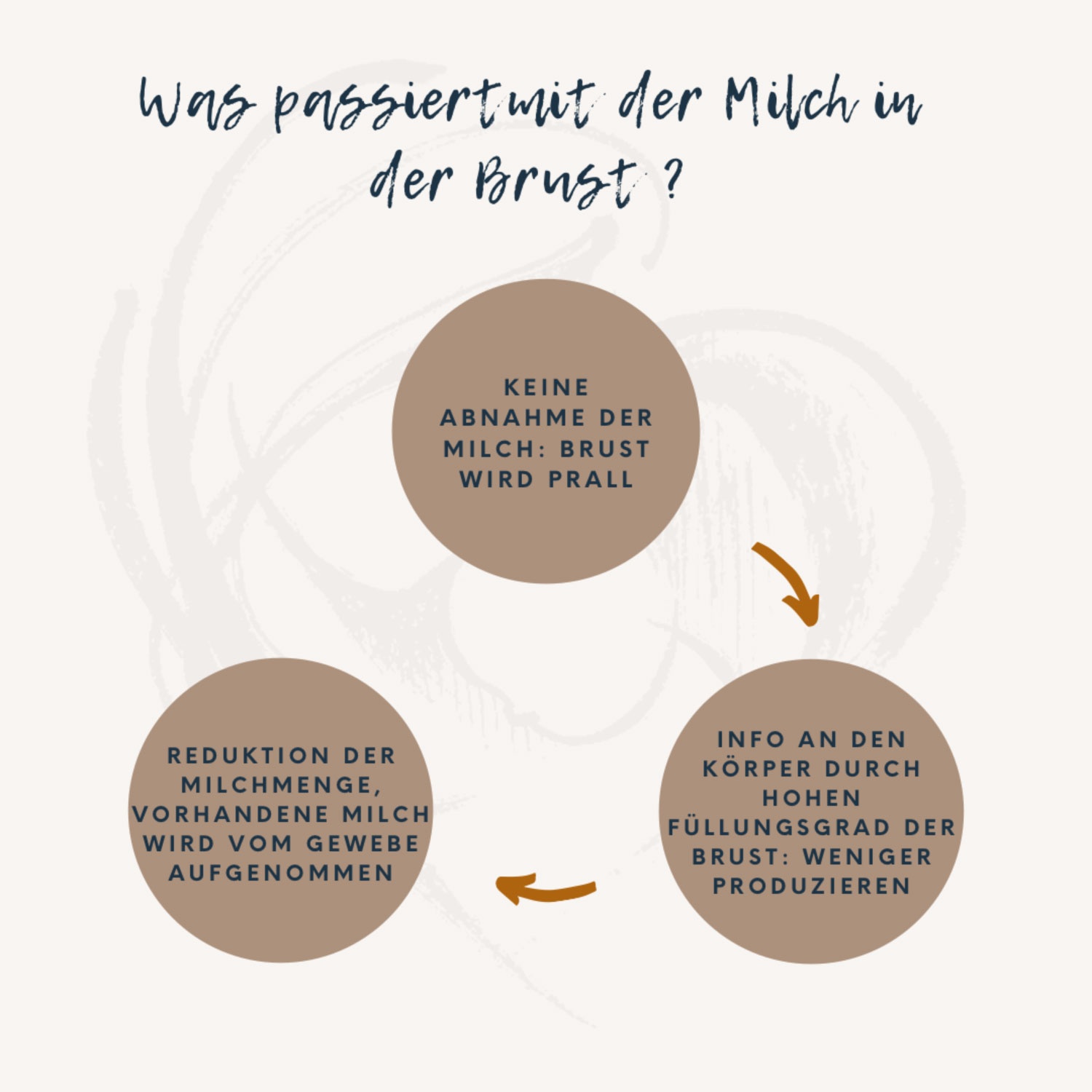
Your breasts automatically adjust to your needs; when you stop breastfeeding, your milk supply decreases. However, the time it takes varies from mother to mother, and it's perfectly normal for your breasts to feel full. Full breasts can actually reduce milk production, but be careful to avoid painful engorgement or mastitis. Massage your breasts regularly or express some milk by hand.
3. Support for milk reduction
If your body tends to produce a lot of milk despite not losing weight, you can reduce milk production with sage tea. Two to three cups a day are recommended. In extreme cases and in the early stages of engorgement, taking homeopathic remedies such as Phytolacca is also an option.
What to do about extremely large breasts?
❌ – Not like this
Do not pump under any circumstances, this will increase the milk supply again.
Please do not press or squeeze the hardened areas. This can lead to tissue damage and inflammation.
✅ – Here's how
A comfortably full breast is beneficial for reducing milk production. If it becomes painful, gently and regularly massage your breasts to loosen any lumps and tissue. Express enough milk by hand, just enough to feel comfortable again, so you don't stimulate your body to produce large amounts again.